Moissanite & Lab-Grown Gemstones
Moissanite and lab-grown coloured stones, set to the same standard as our diamond lines. Moissanite is supplied in D, EF, GH and IJ colour plus fancy colours — grey, black, yellow, champagne, green, blue and pink — with GRA certification.
Moissanite specification
| Hardness | 9.25 on the Mohs scale — second only to diamond |
|---|---|
| Brilliance | Refractive index higher than diamond, producing more fire |
| Colour grades | D · EF · GH · IJ, plus fancy: grey, black, yellow, champagne, green, blue, pink |
| Certification | GRA certified, graded by diamond graders |
| Hearts & Arrows | 8, 10, 12 and 16 hearts-and-arrows cuts available |
| Lab gemstones | Lab-grown ruby, sapphire and emerald |
Twelve cuts, with facet counts
Round brilliant
57–58 facets. The most requested shape, and the benchmark against which the others are cut.
Cushion
81–82 facets. A pillow-like outline sitting between square and round — the highest facet count in the range.
Oval
69–70 facets. Elongated ratios available for buyers who want visual size at a given carat weight.
Pear
71–72 facets. One of the most versatile shapes across pendants, rings and drops.
Emerald
45–46 facets. Step-cut, both a modern and a vintage favourite.
Asscher
57–58 facets. Square step-cut made famous at the turn of the 20th century.
Princess
65–66 facets. A classic that suits a wide range of settings.
Radiant
53–54 facets. Elongated outline with brilliant-cut faceting.
Marquise
57–58 facets. Narrow silhouette demanding precise symmetry.
Heart
56–57 facets. A symbol that has to be cut accurately to read as one.
Baguette
24 facets. Rectangular step-cut, parallel facets arranged like a terrace — the standard side stone.
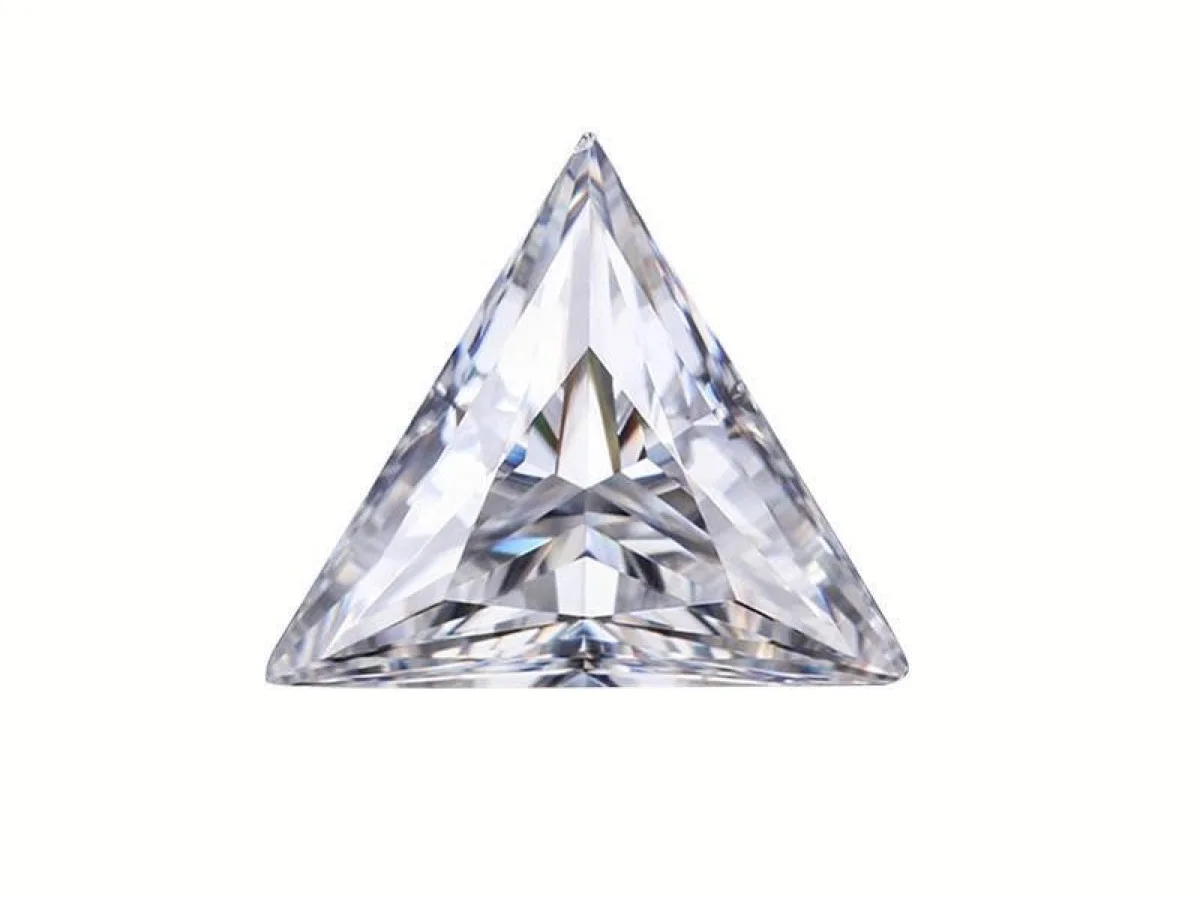
Trillion
Triangular cut with curved or straight sides, table shape varying by design.
What to know before you specify
What moissanite is
Moissanite is silicon carbide, first identified in 1893 by the French chemist Henri Moissan — later a Nobel laureate — in microscopic grains found in an Arizona meteorite crater. He initially believed he had found diamonds. Natural moissanite is extremely rare, so all moissanite in the market today is lab-grown, synthesised after years of development into one of the brightest gemstones available.
How it compares with diamond
Moissanite is materially different from diamond but visually very close: a Mohs hardness of 9.25 against diamond’s 10, and a refractive index higher than diamond, which produces noticeably more fire. It is highly resistant to scratching and abrasion and is suitable for daily wear. As a lab-grown stone it is conflict-free, and it costs materially less than a diamond of comparable size.
How it is graded
While diamonds are graded on all four Cs, moissanite is graded on colour alone — cut and clarity are consistent across quality tiers. We supply D, EF, GH and IJ colour, plus fancy colours including grey, black, yellow, champagne, green, blue and pink. Each stone is inspected, graded by diamond graders and certified by GRA.
Hearts and arrows
Hearts-and-arrows is one of the most exacting proportion cuts available. Cut to ideal proportions, the stone shows eight symmetrical hearts and eight arrows visible under magnification. Beyond the classic eight, we cut ten, twelve and sixteen hearts-and-arrows variants for programmes that want a technical differentiator on the counter.
Lab-grown coloured stones
Lab-grown ruby, sapphire and emerald run on the same industrial chain that grows diamonds, and set into the same designs to the same standard. For a brand, they open coloured-centre programmes at a price point that mined coloured stone cannot reach with consistent supply.
Every centre stone verifiable
Stones ship with IGI or GIA reports under your program — check any report number against the issuing lab's own database before you accept the shipment.